The Challenge
Healthcare appointment booking is inherently friction-filled. Patients frequently submit incomplete or inconsistent information during initial requests,missing insurance details, incorrect dates of birth, or unclear medical context. Each gap introduces failure points: stalled bookings, repeated follow-ups, frustrated patients, and increased load on already overburdened provider offices.
The traditional workaround has been manual concierge operations,teams dedicated to calling patients to fill in missing details, contacting provider offices to confirm availability, negotiating appointment times, and coordinating confirmations, cancellations, or reschedules. At national scale,across 800,000+ healthcare providers,this model becomes prohibitively expensive, slow, and operationally unsustainable.
The real challenge wasn’t automation alone. It was designing a system intelligent enough to manage the nuanced, multi-step conversations human concierges handle daily,while operating reliably at a scale no human workforce could support.
Our Approach
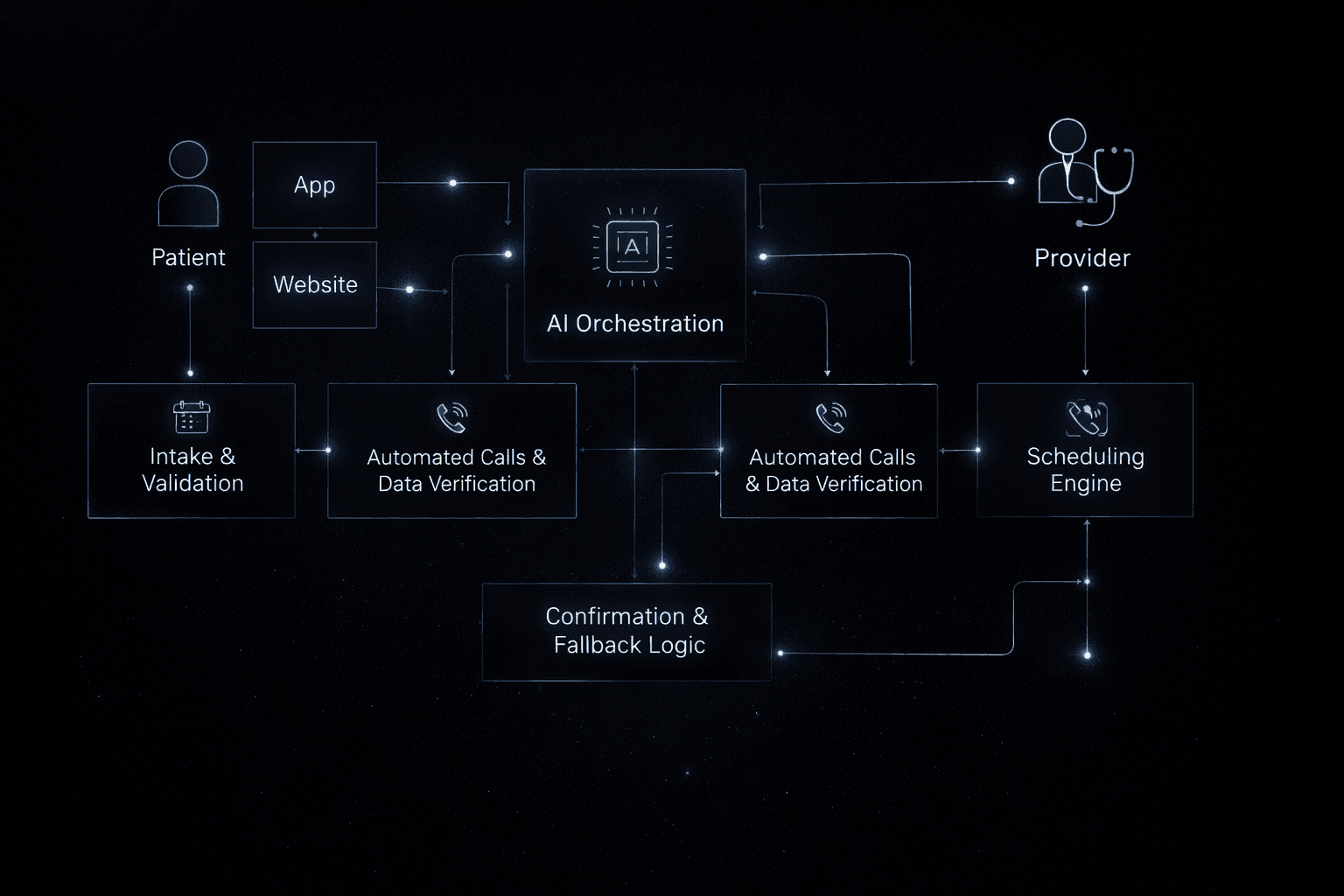
Rather than automating individual steps, we designed the system as an end-to-end orchestration layer—managing the entire appointment lifecycle as a unified process.
Conditional Logic Over Linear Workflows
We treated booking as a sequence of conditional conversations, not a linear form submission. Intake, validation, provider outreach, and confirmation were modeled as interdependent states so the system could adapt to missing information, provider responses, and changing availability.
Intelligent Patient Handling
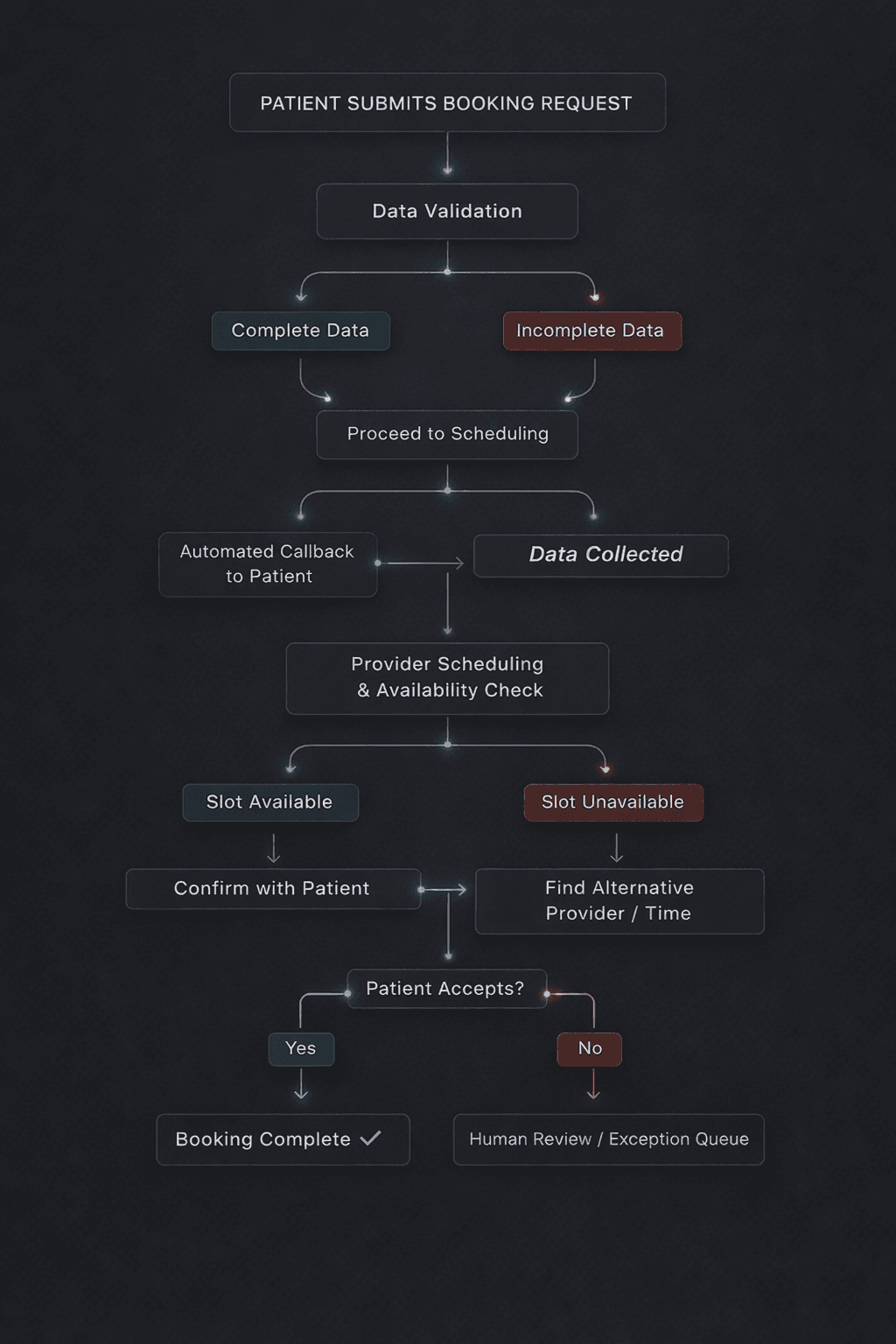
When key details were incomplete—insurance, clinical context, or constraints—the system initiated follow-ups before progressing. This ensured provider offices received clean, actionable booking requests and reduced back-and-forth.
Provider Coordination at Scale
The platform operated within fragmented provider workflows, handling asynchronous responses and negotiating appointment options in real time. When preferred slots weren't available, it routed toward fallback scenarios—alternate providers or time windows aligned with the patient's needs.
Centralized Decision Layer
Every interaction fed back into a central decision layer, maintaining context across touchpoints and preventing redundant outreach. Confirmations, reschedules, and cancellations reached a clean resolution without manual intervention.
The result was a resilient booking system that mirrors concierge decision-making—while operating reliably at national scale.
System Architecture
The system is built around a centralized orchestration layer that manages the full booking lifecycle as a single, stateful process rather than a collection of disconnected tasks.
All patient and provider interactions-intake validation, follow-ups, availability checks, confirmations, and fallback handling-flow through this decision layer. Each interaction updates shared context, allowing the system to make informed decisions without repeating outreach or losing state across touchpoints.
Automated callbacks and provider coordination operate asynchronously, enabling the platform to handle real-world delays and fragmented workflows without blocking progress. When preferred options are unavailable or edge cases arise, the system dynamically evaluates alternatives or routes the flow into a controlled exception path for human review.
The platform processes thousands of concurrent booking requests while maintaining consistency across 800K+ provider integrations. This ensures bookings resolve cleanly and consistently-whether confirmed, rescheduled, or rerouted-while keeping human intervention limited to true exceptions rather than routine operations.
Result & Impact
Higher Booking Completion
By resolving incomplete data upfront and intelligently routing around unavailable slots, the system materially reduced booking failures and patient drop-off across standard appointment flows.
Always-On Booking Experience
The platform operates continuously, enabling patients to submit requests, complete follow-ups, and confirm appointments outside traditional business hours-including evenings, weekends, and holidays.
Reduced Operational Cost
Automated intake, validation, callbacks, and provider coordination eliminated the majority of manual concierge touchpoints, significantly lowering operating costs without sacrificing service quality.
Operational Efficiency at Scale
With human involvement limited to true exceptions, the system processes thousands of concurrent bookings across 800K+ providers, with most requests resolving end-to-end without manual oversight.
The platform supports national-scale expansion through infrastructure scaling rather than proportional increases in operations staff—allowing growth without compounding cost.